The good news about soccer, football, and baseball: outdoor daylight solves the hardest photography problem for you before you even pick up the camera.
In a dark gym, you are fighting for every scrap of light. Outside on a sunny afternoon, you have plenty.
That means a fast shutter comes for free. The camera does not have to make the bad trade-offs it makes indoors.
What outdoor field sports throw at you instead are two different problems: your kid is far away on a big field, and the sun can end up shining straight into your lens.
Fix those two things and the rest is easy.
Shutter speed still matters outdoors
Most parents assume a bright day means they can leave the camera in auto and everything will work out.
It mostly does. But not always.
Auto mode can still pick a shutter speed that is too slow for running play if the sky is overcast or the player is in shade.
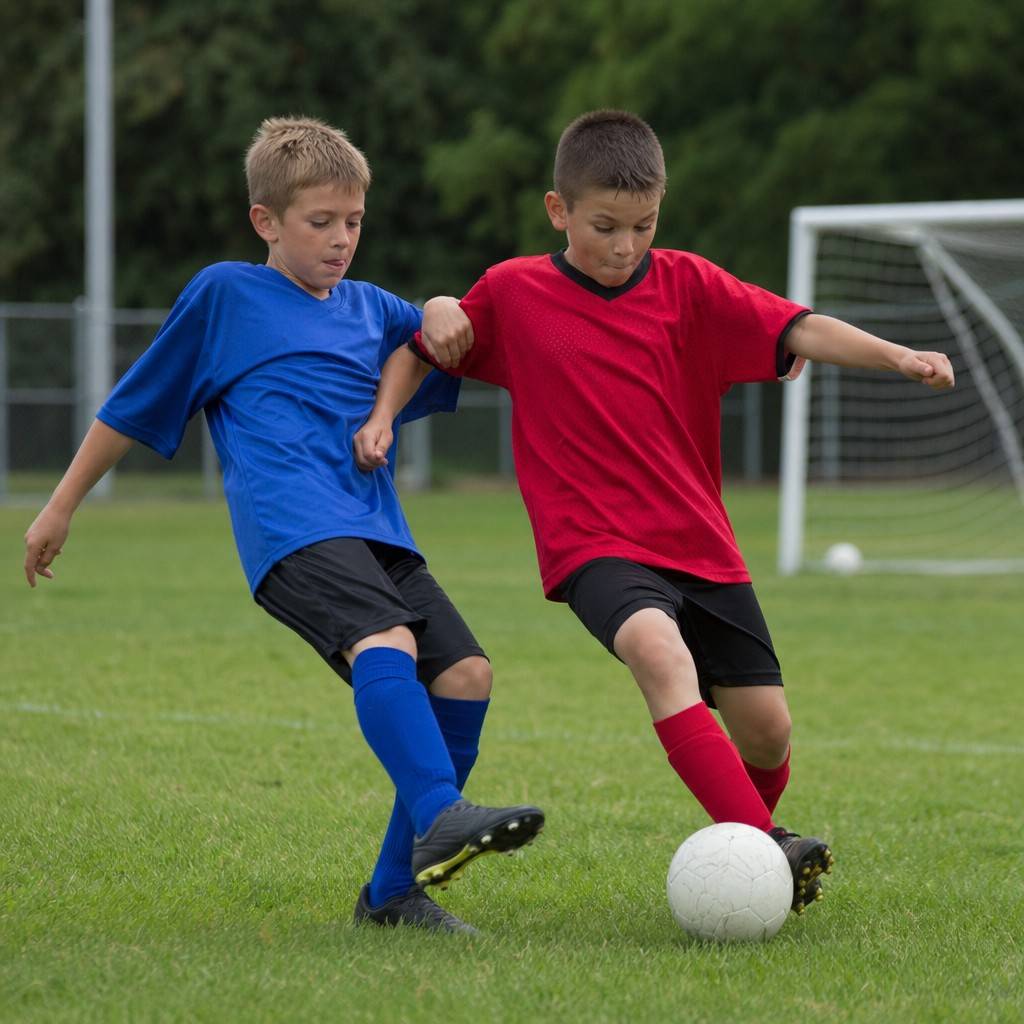
Set shutter priority mode, marked S on most cameras or Tv on Canon. Dial in 1/1000 second for a running player. That stops a full-speed sprint with no visible blur.
- 1/1000 second is the target for running play and kicks.
- 1/500 second is the floor for slower moments or a very bright afternoon.
You pick the shutter speed. The camera handles the rest. Shutter priority is the setting that makes outdoor action shots straightforward.
Distance is the real obstacle on a soccer field
A phone handles outdoor daylight well. The part that catches parents off guard is how small the players look from the sideline.
A phone’s digital zoom falls apart at distance. You get a smear of pixels instead of a real photo.
The phone’s optical lens cannot reach across a full soccer field. A telephoto zoom is what fills the frame from the sideline. Something in the 70 to 200mm or 55 to 250mm range gets you close enough that your kid is actually the subject and not a tiny figure in the middle distance.
If you are on a phone, the practical fix is simpler: get physically closer. Walk up to the touchline and move toward the action.
Where to stand changes everything
Settings take care of exposure. Position takes care of getting shots worth keeping.
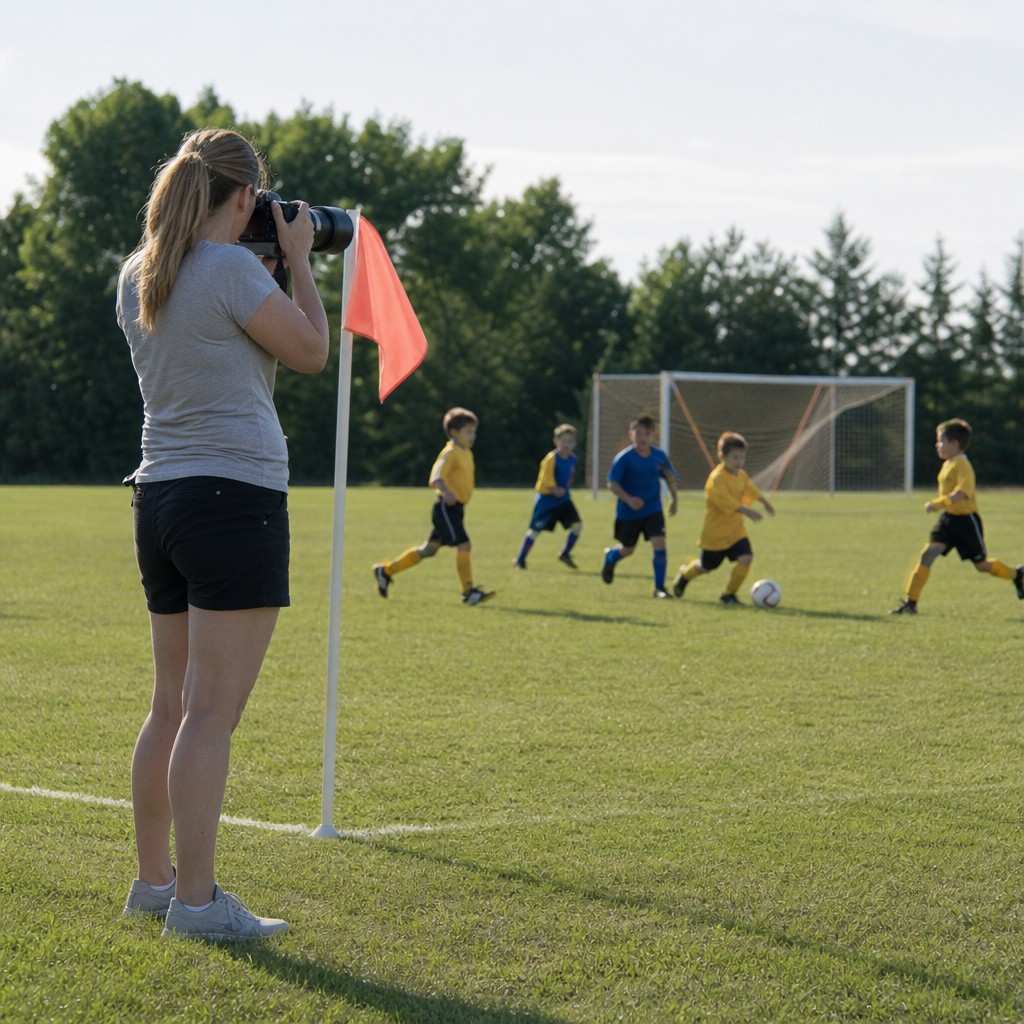
Stand near a corner flag or behind the goal line, not in the middle of the sideline. From there, the play comes toward you instead of moving across your frame.
You see faces instead of backs of heads.
- Near the corner or goal: play runs at you, faces show, and the kick or header lines up in the frame.
- Mid-field: you see a lot of ground, a lot of backs, and very little face.
Move along the sideline as the ball moves. Drift with the play and you end up with better angles almost automatically.
Get to the right spot on the sideline before you worry about settings.
Keep the sun behind you
The second outdoor-specific problem: sun position.
Shoot with the sun at your back so it lights the players’ faces, not your lens.
When the sun is in front of you, players go dark and the lens flares. The photo looks dim even on a bright day, because you are shooting people standing in their own shadow.
Walk to the side of the field where the sun is behind your shoulder. It makes an immediate difference.
Overcast days are the gift. A thin cloud cover turns harsh midday sun into flat, even light from everywhere. No squinting players, no deep shadows under brow ridges, no blown-out sky. Shoot any time of day and the light cooperates.
Focus and burst: the two settings that catch the key moment
Even a well-exposed frame from the right position misses the peak if the focus is soft or the timing is off by a fraction.
Set your camera to continuous focus mode (AF-C on most cameras, AI Servo on Canon). Continuous focus keeps tracking a moving player from the moment you half-press the shutter. A single-shot mode locks once and lets the player run out of it.
Hold the shutter down in burst mode. A header or a kick lasts less than a second. Burst fires a sequence and you keep the one where the foot meets the ball and the expression is right.
- AF-C or AI Servo: tracks the player as they run.
- Burst mode: fires a sequence so the peak moment is in there somewhere.
- Fill the frame: zoom in or move closer so your kid is the photo, not a small figure in a wide field.
The keeper is one frame out of ten or twenty.
That is normal, and that is the entire point of burst.
Phone-specific tips for sideline soccer
A phone does well outdoors when you are close. Distance is where it runs out of road.
A few habits make it work better from the sideline:
- Tap and hold on your kid to lock focus and exposure before the play reaches your area.
- Use burst mode by holding down the shutter button, then go through the sequence and pick the sharpest frame.
- Get as close as you are allowed. Every step closer multiplies what you get out of the phone’s lens.
Distant crossing balls and plays at the far end of the field are not your best shots on a phone. That is the physics of a small lens at distance, not a failure of technique. It is where a camera with a telephoto zoom outperforms a phone most clearly.
Before the game: quick setup list
Set these before kick-off and you will not be adjusting mid-play:
- Mode: shutter priority (S or Tv)
- Shutter speed: 1/1000 second, or 1/500 on a very overcast day
- Focus mode: continuous (AF-C or AI Servo)
- Drive: burst mode
- Sun check: are you shooting with the sun at your back or into your face? Walk to the correct side.
- Position: near the corner or goal line, not mid-field
Outdoor sports in daylight are where beginners and phones do best. The indoor gym is where things get hard. If you want to see how the same approach shifts when the game moves inside, the full breakdown for dark-gym shooting covers the settings that change.