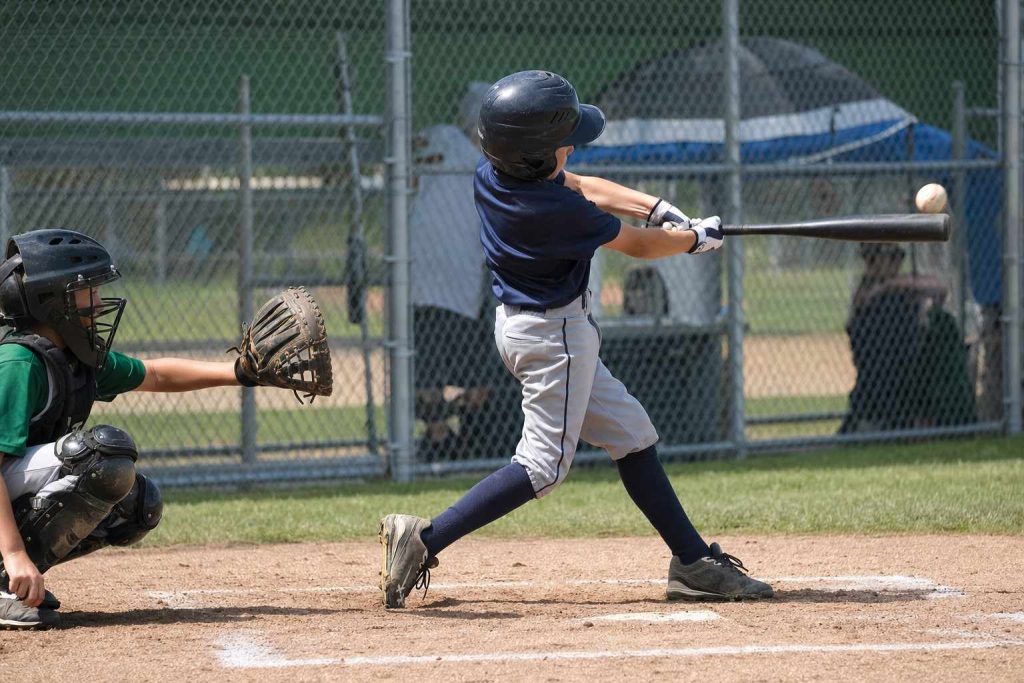
Baseball is the sport where nothing happens for five minutes, then everything happens at once.
A pitch, a swing, a slide, an outfield catch. Each moment is over before a parent’s finger finds the button.
The game rewards anticipation more than constant shooting. Once you know where to point the camera before the play starts, the actual shot becomes straightforward.
A fast shutter is what stops the swing
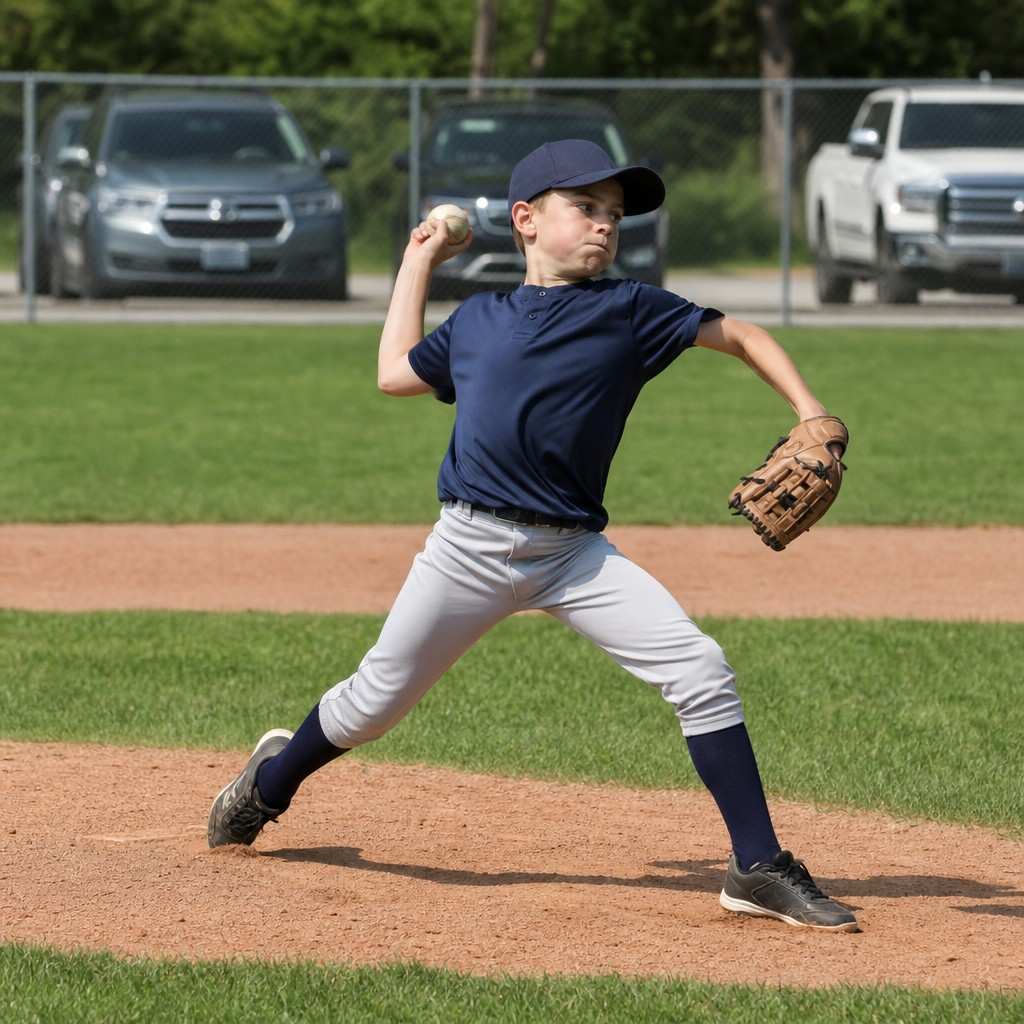
A baseball swing takes roughly a fifth of a second from load to follow-through. That is plenty of time to blur.
Set shutter priority mode, marked S on most cameras or Tv on Canon. This lets you pick the shutter speed while the camera handles everything else.
- 1/1000 second freezes a swing, a pitch release, or a runner mid-stride.
- 1/500 second is the floor for slower plays like a fielder setting up or a baserunner walking.
Stay at 1/1000 for the whole game. You will rarely wish you had gone slower.
Set this before first pitch. The moment you are scrambling with the menu is the moment your kid hits one to center field.
The chain-link problem
The most common complaint from baseball parents is the fence.
Shoot from behind the fence line and the chain-link turns into a visual wall of blurred mesh across the photo. The fix is counter-intuitive: move the lens closer to the problem, not further away.
Press the lens barrel gently against or through the fence opening and open the aperture as wide as it will go (the lowest f-number on your lens, like f/4 or f/2.8). A wide aperture blurs the nearby fence into nothing while keeping the batter sharp. The chain-link dissolves because it is just a few inches in front of the lens, well outside the focal zone.
If the fence has a gap or a low section, that is the better option. Shoot through the gap and the problem does not exist at all.
Do not stand back from the fence trying to get it all in focus. That is the one thing that guarantees mesh in every shot.
Where to stand on the diamond
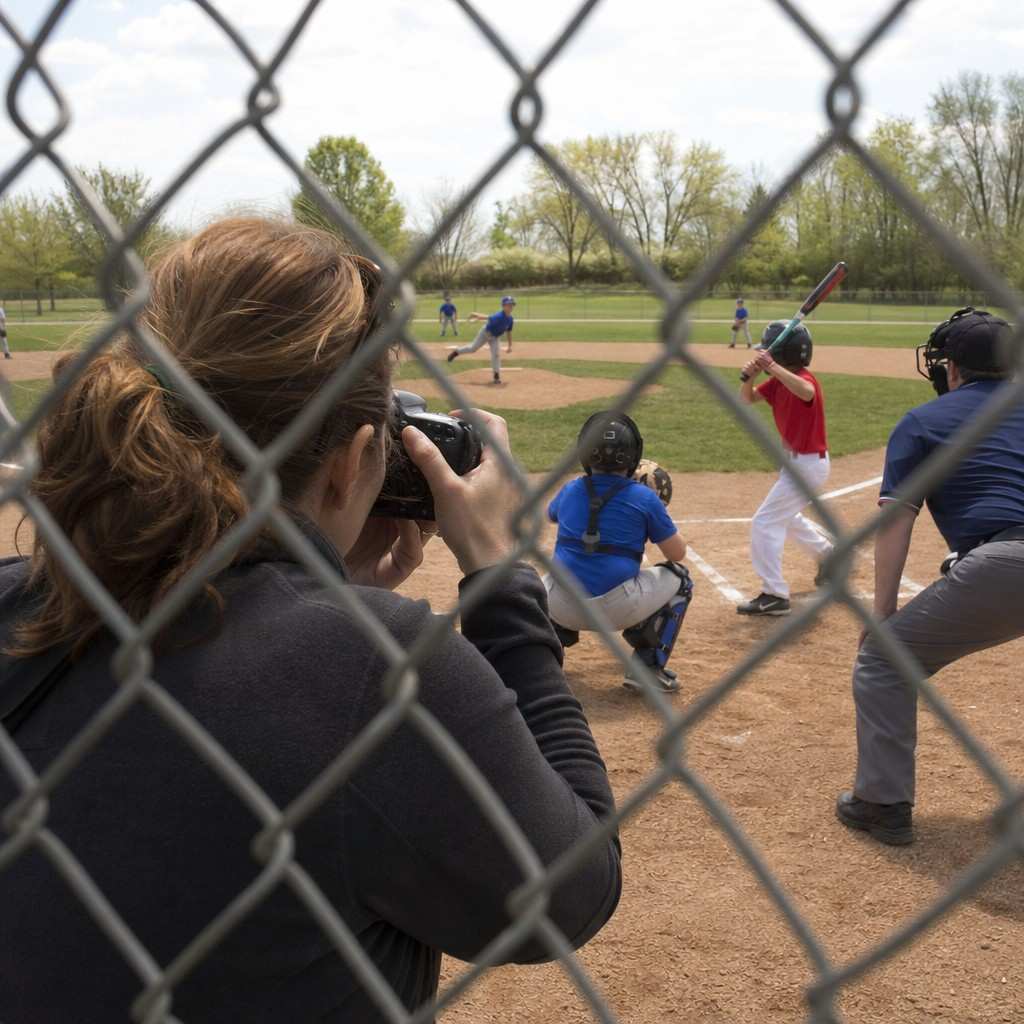
Position settles which plays you can actually catch.
The foul lines are the most useful spots for batter photos. From the first-base or third-base line, you get a side-on view of the swing and the expression in the follow-through. The batter is facing partly toward you instead of fully away.
For base-running plays, stay near the bag where the action is most likely to happen. A slide into second reads better from the infield side than from the dugout end.
- First or third baseline: best angle on the batter and the catcher.
- Near a dugout: clean background, easy access, good angle for close plays at first.
- Behind home plate through the backstop: the chain-link problem is at its worst here. Use it only as a last resort.
Avoid mid-field positions behind the backstop for batter shots. You are shooting through the most chain-link and getting the least face.
The moments worth anticipating
A batter steps in. A pitch is about to happen. A runner edges off the bag.
Pre-focus where you expect the play before it happens. Point the camera at the plate while the pitcher winds up, not while the ball is already mid-air.
The moments with the most payoff:
- Swing at contact. The bat and ball meeting, or the split-second after. This is the center of the game.
- Pitch release. The pitcher’s arm at full extension, the body following through.
- Slide into base. Dust, outstretched arms, the fielder reaching for the tag. Set up near the bag, not home plate.
- Outfield catch. Hard to time from the sideline, but a player tracking a fly ball is worth the burst.
For any of these, the technique is the same: find continuous autofocus (AF-C on most cameras, AI Servo on Canon), point at the relevant player, and keep the continuous autofocus tracking a moving player or runner throughout the play.
Day games vs late afternoon
Midday summer sun is the least kind light for baseball photos.
Harsh overhead sun creates deep shadows under brow ridges and brim hats. Players squint. Their faces go dark under the cap. The photo looks technically fine and visually flat.
Late afternoon, from about two hours before sunset, changes the angle of light enough that faces open up. The sun comes in at a lower angle and hits faces more directly.
Keep the sun behind your shoulder, not in front. Shooting into the sun turns players into silhouettes and the lens flares.
For the full approach to outdoor daylight settings across field sports, the positioning and shutter logic follows the same rules.
Late afternoon at the diamond is when the light cooperates. If you can catch the three o’clock game instead of the noon one, the photos will show it.
Night games under the lights
Stadium lights are designed for watching, not photography. They are significantly dimmer than afternoon daylight.
Treat a night game like a gym. Raise the ISO well past the default: 3200 to 6400 is the normal range, and do not be surprised if 6400 still feels borderline at some parks.
Some grain at 6400 is fine. A clean, blurry photo at ISO 800 is not useful.
Hold the shutter at 1/1000 or at least 1/500 even at night. If the camera cannot get there without going dark, push the ISO higher before you back off the shutter.
The same settings that handle a dark gym handle a night game. If you want the full indoor-light strategy, the approach for low light and gym shooting covers the situation in more depth.
Phone tips at the diamond
A phone at a baseball game is working against two things: distance to the plate and the fence.
Get as close to the fence as possible and press the lens to the mesh if the fence is chain-link. The same physics apply: close enough and the fence blurs away. Tap-hold on the batter or the pitcher to lock focus before the pitch.
- Tap-hold to lock focus on the batter while the pitcher is in the windup.
- Hold the shutter down in burst through the swing sequence.
- Get close to the fence and press the lens opening against the chain-link.
For distance plays (centerfield catches, plays at the far bag), a phone is genuinely limited by the lens. Move to a part of the field where the action comes closer to you rather than trying to stretch the zoom.
Your before-first-pitch setup
Set this before the first batter steps in:
- Mode: shutter priority (S or Tv)
- Shutter speed: 1/1000 second (1/500 floor)
- Focus mode: continuous (AF-C or AI Servo)
- Drive: burst mode
- Position: along the first or third baseline, or near the relevant base
- Sun check: behind your shoulder, not in your eyes
- Night game: ISO 3200 to 6400, shutter still at 1/1000
If you use a camera with a telephoto zoom rather than a phone, dial in the longest end of the zoom from the foul line. You are close enough that a 200mm focal length from baseline fills the frame well.
A baseball game gives you time between pitches to check and adjust. Use it. The next swing is coming and the moment does not wait.