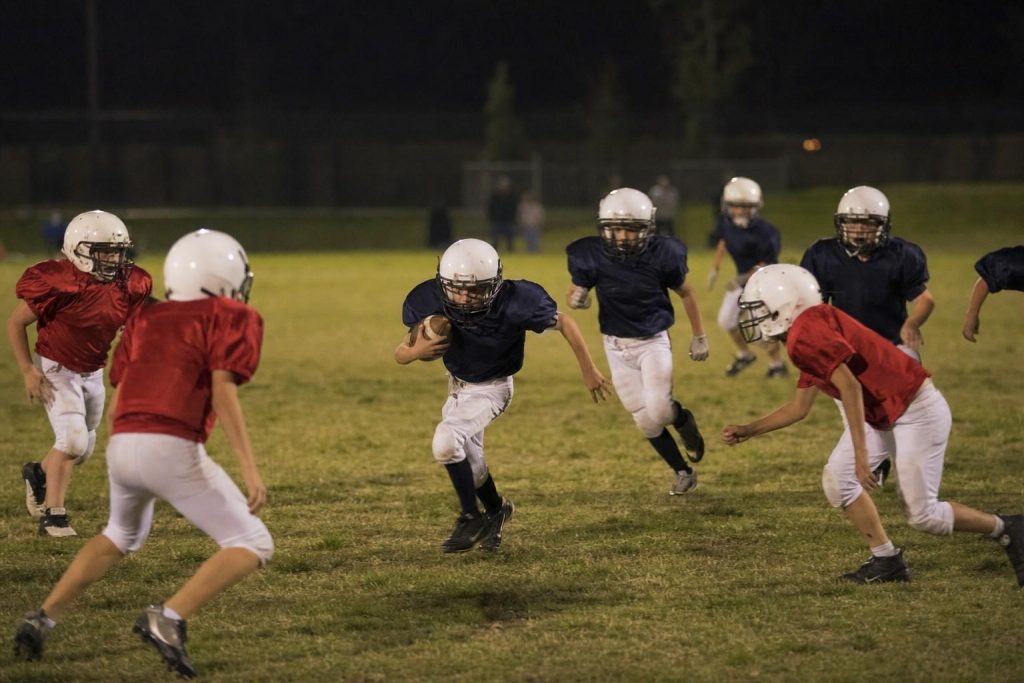
Football hands you two completely different photography challenges depending on when the game kicks off.
A Friday afternoon game under open sky is one of the more forgiving outdoor situations you will face. A Friday night game under stadium lights is something else.
Stadium lights are far dimmer than daylight, and the camera feels that difference even when your eyes do not.
Get comfortable with both cases and your photos will hold up regardless of the schedule.
Day games are the simple case
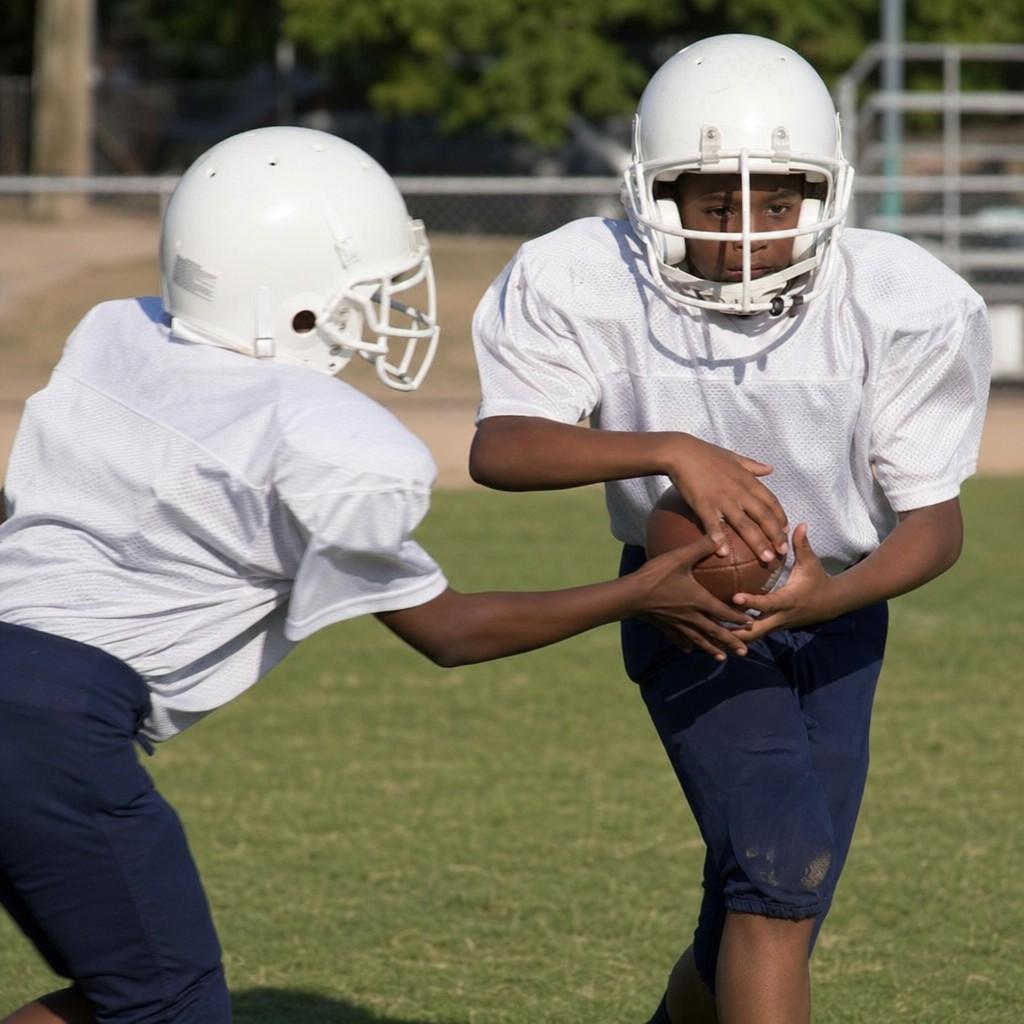
Outdoor daylight solves most of the exposure problem before you even look at your settings.
Set your shutter to 1/1000 second and you can freeze a full-speed sprint, a quarterback’s release, or a receiver’s jump without thinking about anything else.
Keep the sun behind you. When the sun is in front of your lens, the players go dark even on a bright afternoon. Walk to the side of the field where the light falls on their faces, not on your glass.
- 1/1000 second stops a sprint or a hard throw.
- Shutter priority mode (S on most cameras, Tv on Canon) lets you set the number and leave it.
- Sun at your back means faces are lit and not silhouetted.
Overcast days work in your favor. Flat cloud cover removes harsh shadows and lets you shoot from either side of the field.
Night games are really a dark gym
This is where football photography separates the comfortable from the frustrated.
Stadium lights look bright from the stands. To a camera sensor, a lit football field at night is much closer to a school gymnasium than to a sunny afternoon. The light sources are high, concentrated, and still nowhere near daylight intensity.
Treat a night game the same way you would treat a dark gym, with the same indoor low-light approach that fixes gym basketball shots.
The three numbers to set:
- ISO 3200 to 6400. Push it there and leave it. A little grain in a sharp frame is far better than a clean blurry one.
- Aperture as wide as the lens will go. The lowest f-number available. Every bit of light the lens can gather matters on a dark field.
- Shutter at 1/640 to 1/800 second. Slower than 1/640 and a runner starts to blur. Faster than 1/800 and you need more light than most fields can supply at night.
The whole night-game problem is buying back shutter speed from a field that does not want to give it to you.
A fast lens changes what is possible at night. A kit zoom that opens to f/5.6 is fighting the field. A lens that opens to f/2.8 or f/1.8 gathers roughly four times the light. If you want to understand how lens choice plays into situations like this, the guide to cameras and lenses for kids’ sports runs through the options by budget.
The field is big and the action is far away
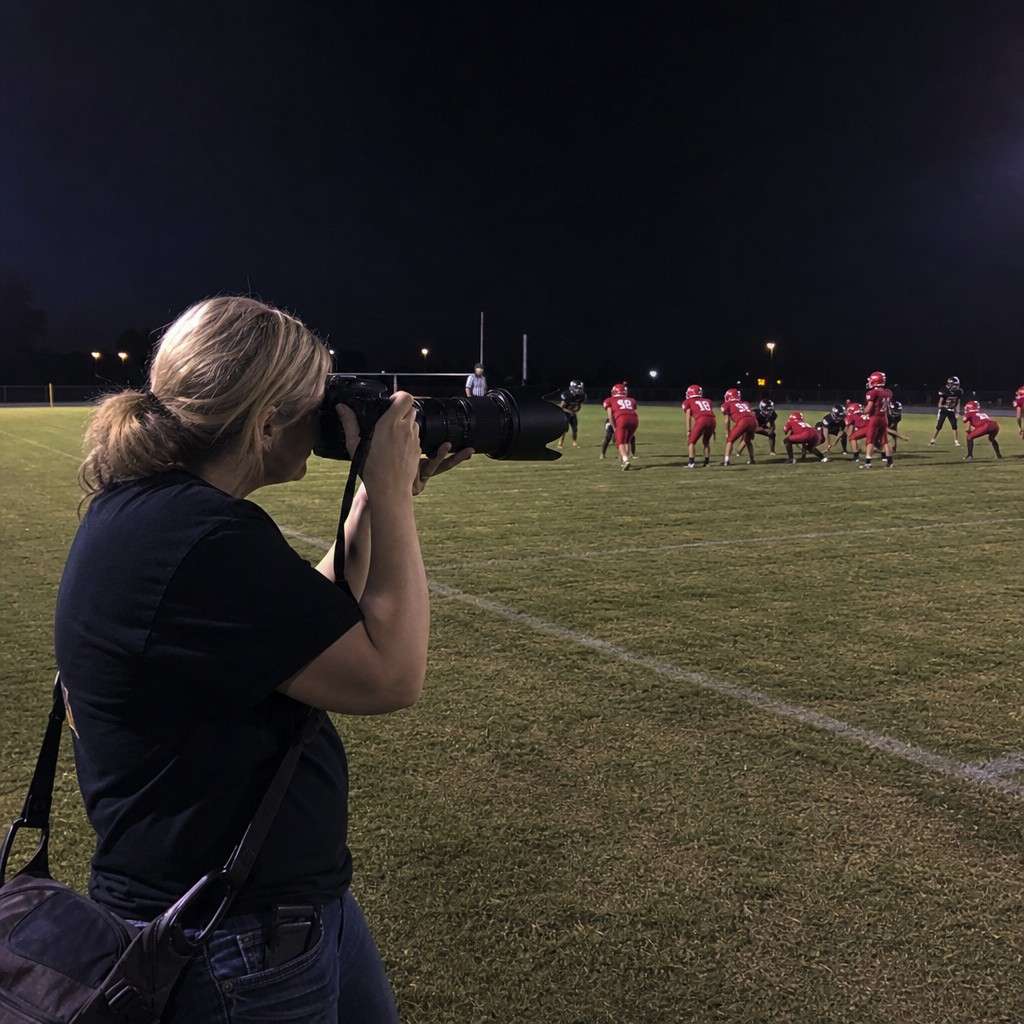
This applies at any hour.
A phone’s optical lens cannot cover a football field from the sideline. You will get a zoomed-in smear rather than a usable photo if you are shooting from twenty yards out with digital zoom.
On a camera, a telephoto in the 70 to 200mm or 55 to 250mm range fills the frame from the sideline. At night, reach and aperture pull against each other: a longer, cheaper lens typically has a smaller maximum aperture, which hurts you in the dark. A fast telephoto that opens wide and reaches far is genuinely useful for night football.
On a phone, the practical answer is your feet. Get as close to the sideline as you are allowed, and move toward the play.
Where to stand on the sideline
Position determines whether you get faces or backs of helmets.
Stand near the line of scrimmage on the sideline, or in the end zone so that plays develop toward you. From the end zone, a run or a pass route comes straight at your lens and you see the ball, the player’s face, and the action all at once.
Move with the ball as it advances down the field. A static spot at mid-field gives you mostly sideline views of the pile-up and not much else.
- Near the line of scrimmage: you see the snap, the handoff, and any run toward the far end.
- End zone: plays come toward you and faces fill the frame naturally.
- Mid-field: wide view, fewer good angles, more backs and helmets.
Drift with the ball during a drive. Ten plays from the same yard-line means ten shots of similar angles. Walking the sideline means you end up behind the play as often as you end up in front of it.
Timing the moments
Football has a rhythm that other field sports like baseball also share: long pauses, then an explosion of action that lasts two or three seconds.
The snap is the trigger. Everything worth photographing happens within the first few seconds after the ball moves.
Anticipate the snap and start your burst as the ball leaves the center’s hands. The handoff, the quarterback’s throwing motion, the receiver going up for a catch, a runner breaking through the line, those frames are all in the first few seconds.
Key moments worth waiting for:
- The snap and handoff.
- The quarterback’s release.
- A receiver catching or jumping for a ball.
- A runner at full stretch or mid-tackle.
- The defensive stop and the moment of contact.
Continuous autofocus tracks a runner as the play develops. Set your camera to continuous focus mode (AF-C on most cameras, AI Servo on Canon) so it stays on the player through the run instead of locking once and letting the subject go soft.
Hold burst mode through the whole play and keep the best frame.
Phones struggle most at night games
Night football is the hardest case for a phone camera.
A phone can handle football in daylight if you are close. A dark field at night is near the edge of what the hardware can do.
The physics do not bend: a small sensor in dim light with fast motion is a difficult combination. The night mode that works for a landscape or a portrait is too slow for a sprinting receiver.
What helps:
- Get as close to the sideline as you are allowed and focus on plays that happen near you, not the far end.
- Tap and hold on the field to lock exposure before a play develops. This stops the phone from over-brightening the dark background.
- Accept that distant plays and fast breaks down the far end are not your best shots tonight. The phone will give you blurry results at distance, and that is a physics limit, not a technique failure.
A tight shot of your kid at the line of scrimmage, from a few yards away, is a better photo than a zoomed-in smear of a touchdown run at the far end zone.
Your before-kickoff setup
Day game:
- Mode: shutter priority (S or Tv)
- Shutter: 1/1000 second
- Focus: continuous (AF-C or AI Servo)
- Drive: burst mode
- Sun check: light at your back, not in your face
Night game (same base, three changes):
- ISO: 3200 to 6400
- Aperture: widest available (lowest f-number)
- Shutter: 1/640 to 1/800 second
Get your position before kickoff, not after the first series. Walking into the end zone during a play to find a better angle means missing the play while you move.
A fast shutter and a good spot on the sideline matter more than any piece of gear on the list.